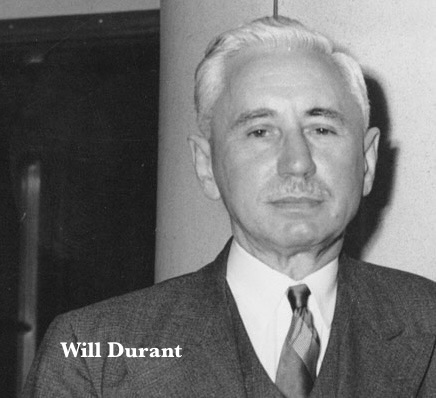
No less a philosopher and historian than Will Durant has commented on the danger to a civilization of increasing wealth disparity, such as we see in the U.S. today, between the “haves” and relative “have nots” of society. Historically such conditions tend to resolve themselves in revolution of one kind or another, often resulting in dictatorships and the loss of freedom and human rights. Other attempted solutions have been semi- revolutionary gradients, like socialisms of various kinds, which historically also tend to fail. A prime reason for this is that socialism (and communism) both make the mistake of conflating politics and economics. Apparently, it is not well understood that politics and economics are separate subjects; each with different laws. No political system will ever solve economics problems; only intelligent applications of economics basics can do that.
Another observation made by Durant was that one of the huge reasons for wealth disparity in a society is the obvious fact that individual people are not equal. Some are smarter and some less so. Some are ambitious and some less so. Some are great communicators, some average, and some withdrawn. There is no human being alive who is the exact equal of someone else in terms of ability, despite what the Declaration of Independence says. Should all have the benefit of equal rights? Absolutely! Equal opportunity? Certainly! But what they do with those rights and opportunities is up to them. This is the essence of freedom. It is where human rights and economics interface, for, tracing it way, way back, you’ll find that a being has a right to his own creations, just as he has a right to communicate, or not, as he chooses. Should that being find that he desires the creations of another, and that the other desires his, then the concept of exchange enters in, and so we have economics.
Alright, this is simple enough. But in looking all this over, with an eye toward finding any other causes for the wealth disparity currently afflicting our society, we find that there is; that it lies within the field of economics, and so can be solved with economic measures—no revolution required. No question that doing so would result in a legendary hue and cry from the vested interests currently benefitting from the situation, but I would argue that the solution must be worked out and implemented anyway, and as fast as possible if we want to save our free society. This “hidden” cause of wealth disparity is a condition that has afflicted the U.S. economy for more than a century, and that is simply inflation, a condition that results when increased government spending and resultant money creation pump that money into circulation at a pace that outstrips the production of goods and services. Inevitably, this reduces the value of the money and raises the costs of goods and services. It is important to understand that the raised costs are not themselves inflation but are the consequences of it.
I hope that is understood, because we are going to build on that concept to demonstrate a main cause of wealth disparity. The first point to grasp is that when that “government created” money is spent into circulation it does not enter equally all elements of society simultaneously, instead usually arriving in the hands of government contractors and corporations first, when the relative value of the money is still higher. The price rises in goods and services take place a bit later, after the money has been paid as wages and then spent again by workers for goods and services. Repeated over and over, the fact just described is an important factor. Thus, the wealthier class generally has access to money before it has experienced the full inflationary degrade, and so can be spent when it has higher value. This automatically gives the industrialist/corporate class an advantage. Also, already wealthier people tend to have their assets in relatively “inflation proof” investments, such as real estate, securities of various kinds, precious metals etc. Those investments tend to rise in value at a pace equal to the inflationary effect as it takes hold. In addition, any loans or mortgages they may have were possibly taken on when the money was worth more, but are being paid off with money that is actually worth less. Poorer people, however, tend to be day to day in their economics, spending their money as they make it. They don’t own their homes, they rent them, and when they do save it is usually in low interest accounts that don’t keep pace with the rate of inflation. The result of all this is that the money in their pocket today is worth less than it was when they made it last week, last month, or last year. Where did that value go? This is the hidden tax, and it fuels a gradual wealth transfer from the lower economic bands of society, to the higher.
To me this is the real “social injustice” to handle in our society, that once handled would level the playing field for all to make the fullest use of their freedoms and abilities.